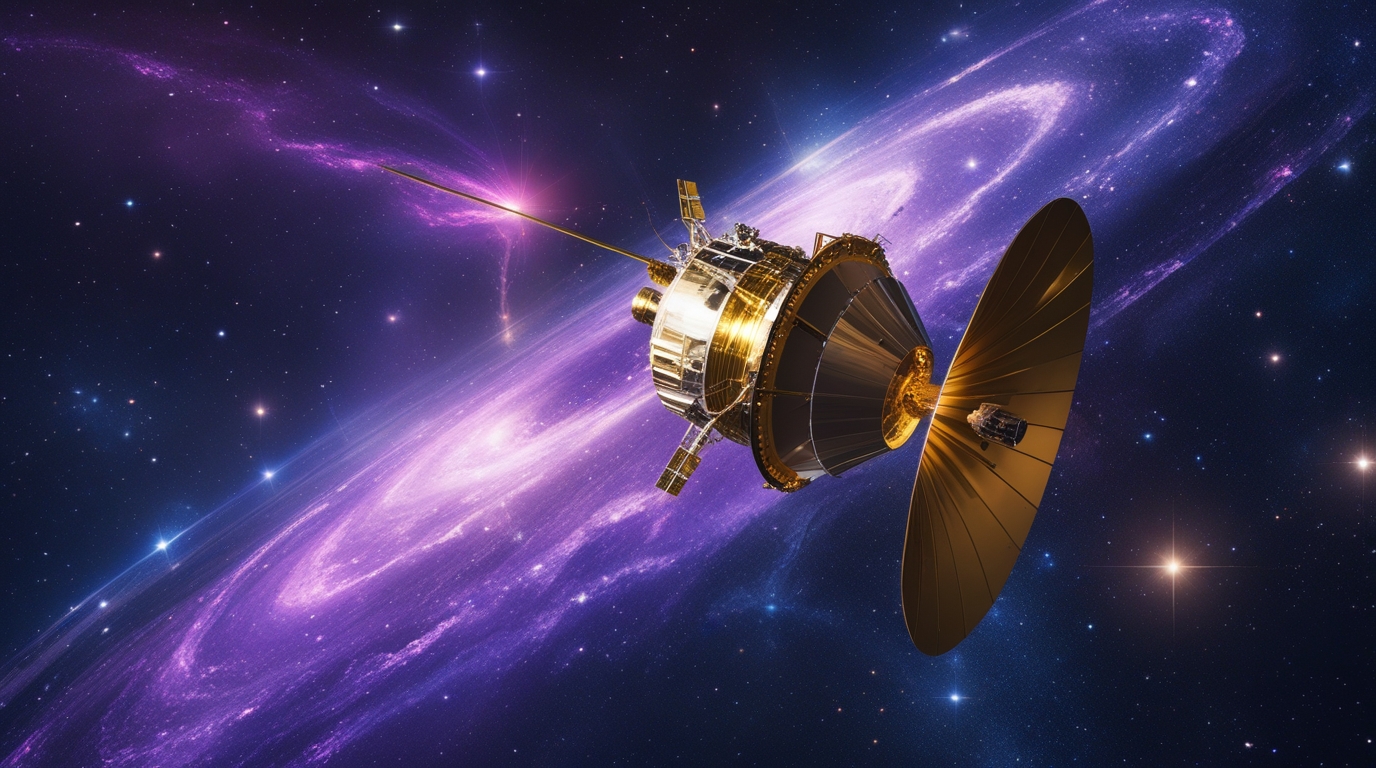
Introduction to Voyager 1 Intercepts Song in Space
When humanity first launched Voyager 1 Intercepts Song in Space in 1977, no one could fully imagine the mysteries it would uncover more than four decades later. Now traveling through interstellar space, the spacecraft has recently intercepted what scientists describe as a “song-like signal”—a rhythmic, structured pattern unlike any naturally occurring radio emission previously recorded. This unexpected discovery has sparked intense curiosity and debate: is it a beautiful sign of cosmic harmony or an unsettling clue that something unknown is unfolding in the dark reaches of space? The encounter offers a moment of wonder, fear, imagination, and scientific awakening, all wrapped within a signal that challenges everything we thought we understood about the universe.
The Moment of Detection
Voyager 1 Intercepts Song in Space, drifting farther away from Earth than any other spacecraft in history, routinely sends back weak data streams from beyond the heliosphere. This time, the spacecraft captured a patterned oscillation repeating in intervals too precise to be random. The rhythm was subtle, almost melodic, leading many to describe it metaphorically as a “song in space.”
The detection occurred as the spacecraft entered a region where plasma waves behave differently, creating a perfect environment for unusual signals to resonate. Although the sound was not audible in its raw form, scientists translated the frequency patterns into an audio format, revealing a haunting, song-like sequence that left listeners both amazed and unsettled. The moment marked a historic event—proof that interstellar space may hold more complexity than previously believed.
What Makes the Signal Unique
Natural cosmic signals typically fluctuate irregularly, shaped by stellar winds, magnetic fields, and particle movements. What Voyager 1 Intercepts Song in Space captured stands apart due to its repetitive structure. Each frequency cluster maintains a consistent spacing, almost like musical notes arranged with purpose. The signal’s waveforms rise and fall with a smoothness that resembles composition rather than chaos.
Even more compelling is its frequency consistency: it repeats with mathematical exactness over long periods, defying expected cosmic noise. This regularity raises a profound question—could this be a product of intelligent origin, or are we finally observing an unknown natural phenomenon? The combination of organization, rhythm, and harmony is what transformed a routine data packet into a globally discussed mystery.
Reactions Within the Scientific Community
The scientific community responded with a mixture of enthusiasm and caution. Some researchers view the signal as an extraordinary scientific treasure, potentially the first structured pattern ever detected outside our solar system. They argue that even if the cause is natural, discovering a new cosmic phenomenon is monumental. At the same time, skeptics urge restraint, warning that humans often impose patterns where none exist.
They insist that plasma oscillations or turbulent magnetic fields might simply be behaving in ways not yet documented. Yet, despite these debates, one thing is certain: the signal has triggered one of the most intense analyses in modern space research. Scientists across the globe are re-examining old Voyager data, hoping to find faint echoes of similar patterns buried in decades of recordings.
Could It Be Artificial?
The possibility of an artificial origin injects both excitement and fear into the discussion. Supporters of the artificial hypothesis point to the unmistakable mathematical precision in the wave cycles, arguing that nature rarely produces such clean symmetry over long durations. The signal also shifts pitch in a way that feels intentional, leading some theorists to suspect it could be a form of encoded communication.
However, there is no evidence to directly support the existence of another civilization behind the signal, and leading experts caution that extraordinary claims require extraordinary proof. Nonetheless, the idea that Voyager 1 Intercepts Song in Space—humanity’s ambassador to the stars—might have picked up an intentional interstellar message captures imaginations worldwide. The possibility gives rise to both hope for connection and anxiety about the unknown.


A New Look at Interstellar Space
Before this discovery, interstellar space was often viewed as a cold, silent expanse filled mostly with dust and drifting particles. The intercepted signal suggests that the space between stars may be far more active and structured. Plasma waves, magnetic flux regions, and interstellar turbulence might interact in sophisticated ways, creating patterns that mimic or even surpass human musicality.
If confirmed as natural, this would revolutionize our understanding of interstellar physics and show that the universe possesses forms of harmony shaped by cosmic forces rather than biological intelligence. Such discoveries allow scientists to rethink how sound, rhythm, and motion occur at astronomical distances, turning interstellar space into a kind of cosmic concert hall where energies dance in ways we are only beginning to decode.
The Emotional Impact on Humanity
The idea that Voyager 1 Intercepts Song in Space captured a “song” resonates deeply with people around the world. Some interpret it as a poetic symbol of humanity’s connection to the universe—a comforting reminder that we are not alone. Others fear what it might imply, imagining that the signal could be a distress call, a warning, or even an unintended leak from something we are not yet prepared to encounter. Regardless of interpretation, the public fascination is undeniable. People have been listening to the processed audio, sharing emotional reactions, and discussing theories across social media. The discovery blends science with human imagination, proving that space exploration continues to inspire feelings of wonder, curiosity, and existential reflection.
How Voyager 1 Intercepts Song in Space Is Still Working
The fact that Voyager 1 Intercepts Song in Space can still detect anything at all adds another layer of wonder to this event. Designed with 1970s technology and expected to last only a few decades, the spacecraft continues to operate far beyond its intended lifespan. Its instruments, though weakened by age, remain capable of sensing faint signals from beyond the solar system. This endurance has made Voyager 1 Intercepts Song in Space not just a scientific tool but a symbol of human ingenuity and endurance. The “song” it intercepted is another testament to the power of engineering, proving that even outdated technology can deliver groundbreaking discoveries when exploring the right frontier.
What Scientists Plan to Do Next
The next steps involve deep analysis of the signal’s structure. Researchers will examine variations, attempt to decode possible patterns, compare the data against known cosmic models, and simulate conditions that might produce similar emissions. Collaborations between astrophysicists, mathematicians, linguists, and even sound engineers will be necessary to fully interpret the signal. There is also talk of comparing the signal with recordings from other spacecraft, such as Voyager 2 or New Horizons, to identify any matching patterns. If repeated signals appear, the discovery could escalate into one of the most significant scientific breakthroughs in human history. Future radio telescopes may also be directed toward the region where the signal originated, allowing Earth-based equipment to monitor for echoes or repetitions.
The Philosophical Implications
Beyond science, the discovery forces humanity to confront timeless philosophical questions. If the signal is natural, it demonstrates the beauty and complexity of the universe, reminding us that nature’s creativity extends far beyond Earth. If artificial, the implications are staggering—we may have encountered evidence of intelligence older and farther away than we ever imagined. Either possibility expands our perspective. It nudges humanity to reconsider our place in the cosmos, challenging us to think beyond our planet, beyond our species, and beyond our expectations. Such discoveries are pivotal moments in human history, capable of shifting culture, science, and worldview.

A Message from the Universe or a Mirror of Ourselves?
Whether the signal represents communication, cosmic rhythm, or an unexplored phenomenon, it acts as a mirror reflecting humanity’s hopes, fears, and desire for connection. People are drawn to the idea of a song in space because it evokes emotion—a sense that the universe might be speaking in its own language. Perhaps the signal echoes our longing to know we are not alone. Perhaps it challenges our belief that we understand the universe. Or perhaps it simply shows that beauty and mystery exist in places we never thought to look. In every interpretation, the signal enriches our understanding of the cosmos by inviting curiosity rather than providing answers.
Conclusion
The moment Voyager 1 Intercepts Song in Space intercepted a song-like signal in interstellar space became a landmark event in human exploration. Whether natural or artificial, the rhythmic pattern offers a combination of wonder and uncertainty that captures both scientific inquiry and human imagination. The discovery challenges our assumptions, sparks debate, and encourages deeper study of the universe beyond the heliosphere. It reminds us that even after decades of drifting through the cosmic dark, Voyager 1 Intercepts Song in Space continues to expand the boundaries of what we know about space. As scientists continue decoding the mysterious signal, humanity stands on the edge of a new frontier—one filled with beauty, questions, and possibilities waiting to be explored.